Home / Questions
Good to know
Straight answers to what people ask first. If yours is not here, ask the studio directly.
What is a Luminary?
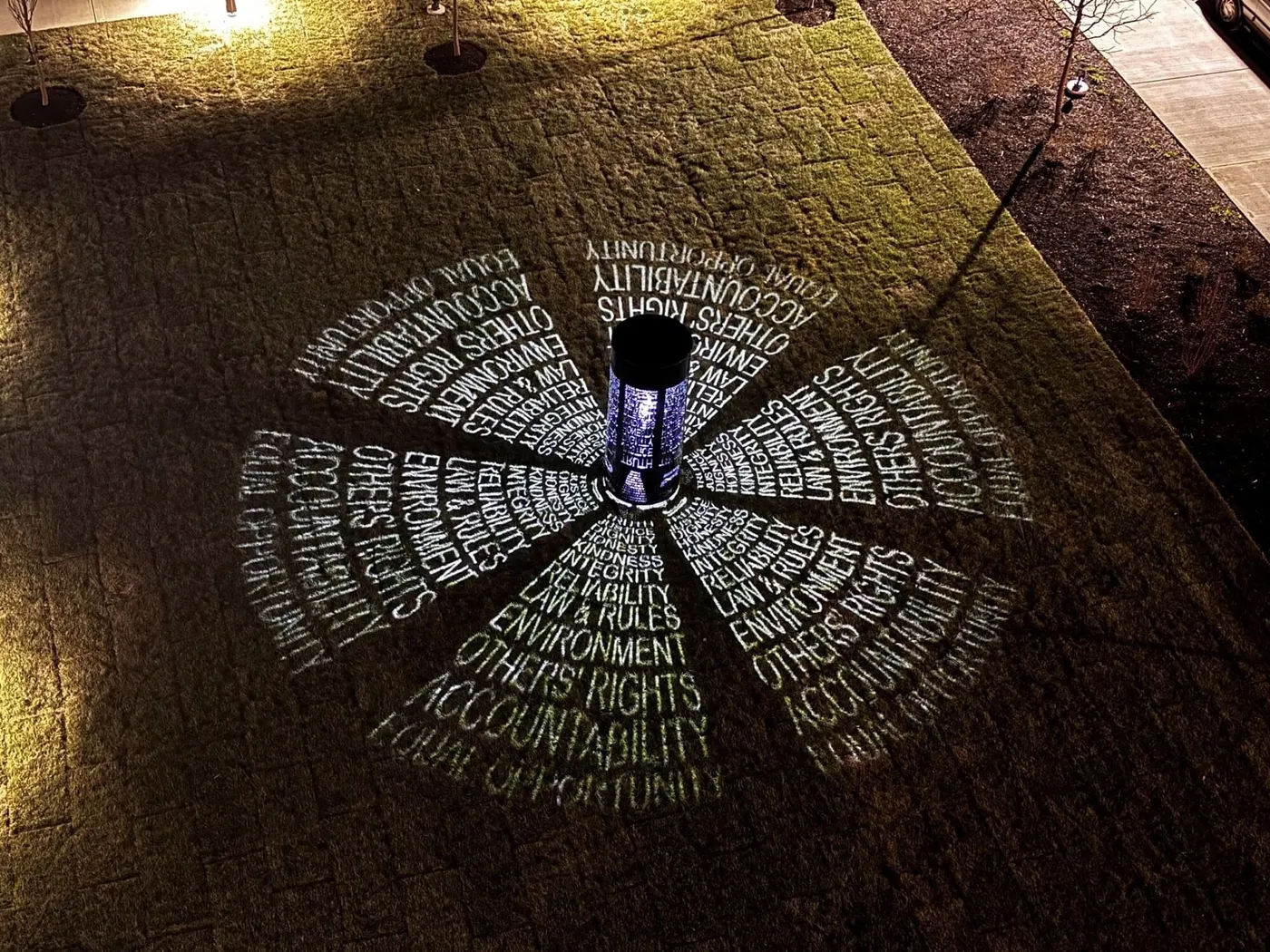
A Luminary is a large outdoor sculpture made of stainless steel with your words, logo, emblem, names, or artwork cut through its walls and a projection light built inside. By day it is a steel sculpture. After dark the light shines out through every cut and writes the design in a full circle on the ground around it. Thornburg Design Studio designs and builds them by hand in Indiana.
Is it a projector or a sculpture?
It is a sculpture. The light inside is one part of it, sealed in the steel body. What you buy is a permanent, custom monument: the steel form, the cut design, the light, and the projection it makes on the ground.
How is a Luminary different from a lit sign or a regular monument?
A sign is read from one direction, and a monument is looked at. A Luminary is walked through. At night its message is written on the ground in every direction, so people stand inside the words. By day it stands as a work of art in steel; by night it becomes a landmark people gather around.
Why do the letters on the steel look upside down?
It is the question everyone asks first. The letters are cut so they read correctly where it matters, on the ground. On the steel they read as an abstract pattern by day, and come together the moment the light switches on.
How big is a Luminary?
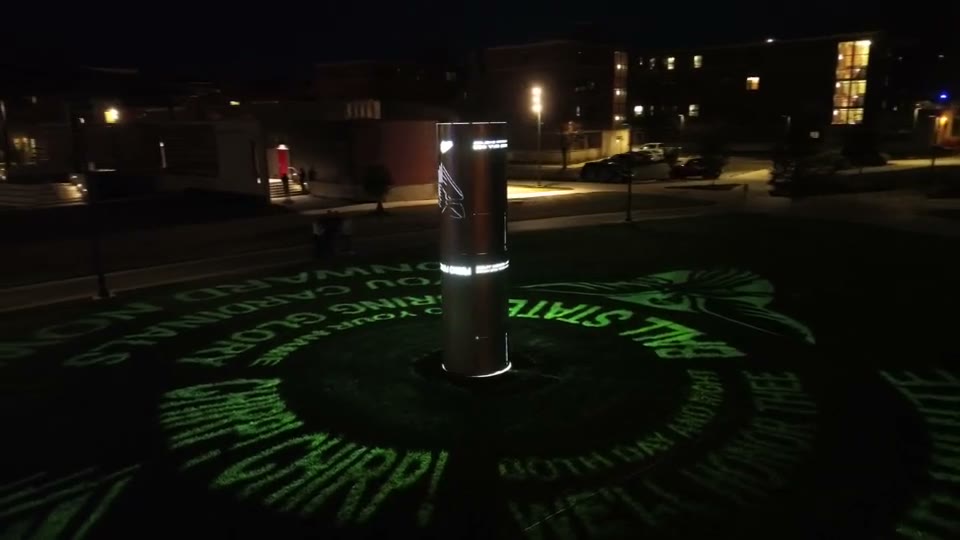
Each one is sized for its site. The Ball State University Luminary is 16 feet tall, 54 inches in diameter, and weighs about 3,800 pounds.
Can the design honor a donor, a class, or a person?
Yes. Names, class years, dedications, values, mascots, and crests can all be cut into the steel and projected onto the ground, which makes a Luminary a lasting form of recognition that people see every night.
What is a Luminary made of?
Heavy 7-gauge, 316-grade stainless steel, the most corrosion-resistant grade in common use. It can be left in a satin steel finish, like the Ball State piece, or powder coated in a color, like the black Plainfield Core Values Lantern.
Will it rust or wear outdoors?
316 stainless steel does not rust like ordinary steel. Over the years it may take on a slight, even patina. It is built to stand outdoors permanently in rain, snow, and summer heat.
What if it gets scratched or vandalized?
The satin finish was chosen for exactly this. It is a random scratch pattern rather than a straight brushed grain, so a damaged area can be sanded back on site and blended in until it looks the same as the rest.
What light does it use?
Each Luminary is lit by a professional 1500-watt projection light made by Infinity Projectors, built into the sculpture.
How far does the projection reach?
At Ball State the words reach about 35 feet out from the base, a circle roughly 75 feet across. The Plainfield piece casts about 20 feet out. Depending on the height of the sculpture, the design can be pushed 50 to 60 feet out.
What color is the light?
The light is white. On a lawn the projected words glow green, which is why the Ball State and Plainfield projections look green on the grass.
What surfaces can it project onto?
Grass, concrete, pavers, and stone all work. The design is planned for the ground at your site.
How is it powered and switched on?
It is wired into the site lighting, the same way as nearby pole lights or street lights, so it comes on and goes off with them on their timer or light sensor.
What kind of foundation does it need?
A reinforced concrete foundation, about 7 by 7 feet and roughly 32 inches deep at Ball State, with only the round top showing above the grass. The studio supplies engineered drawings and an exact anchor-bolt template, and your concrete contractor pours it.
Who installs it?
Thornburg Design Studio delivers and sets the Luminary. Your team handles permits, site preparation, utility marking, and the foundation, using the studio's drawings.
Where do you install?
Anywhere in the contiguous United States. The studio is based outside Muncie, Indiana.
Can we see it before it is built?
Yes. After rounds of design meetings and 3D renderings, the studio builds a full-size mock-up and lights it outdoors. Within about 150 miles of Delaware County, Indiana, it can be set up and lit on your own site. Farther away, it is lit at the studio and you receive drone footage, photos, and measurements. Three or four rounds of changes are included.
How much does a Luminary cost?
Every Luminary is a custom commission, so the investment depends on size, design, finish, and site. The design process, renderings, full-size mock-up, fabrication, delivery, and installation are all part of one proposal. Request a proposal to start the conversation.
How long does a project take?
Mostly it depends on how quickly decisions are made. Renderings and a mock-up can be ready in a few weeks. With a clear design brief and regular meetings, a Luminary can go from first meeting to installation in about four months.
How are Luminaries usually funded?
Most are funded by a foundation, a lead donor, a class gift, a capital project budget, or a public-art allocation. The Ball State Luminary was commissioned by the Ball State Foundation. The renderings and mock-up give a board or donor what they need to say yes.